
the art of resolver: Creativity Under Scarcity
For a long time, I have been thinking about the quiet relationship between scarcity and creativity that emerges within Latin American communities.
Growing up in Venezuela, scarcity was not an abstract concept but an unfriendly visitor in our daily life. Access to water, electricity, internet, safety, education, and stable work was never guaranteed. Life unfolded under conditions of uncertainty, where planning was fragile and adaptability became essential. Yet, it was precisely within these limitations that creativity learned to operate; not as an artistic luxury or choice, but as a survival tool.
When resources are scarce, imagination becomes abundant. People learn to resolver: to fix, invent, reuse, and reimagine. Objects rarely serve a single purpose. Materials are extended, transformed, and given second or third lives. A plastic Mavesa butter container becomes a manual shower, a container, a tool. A blackout can become a communal neighbour or family gathering. Scarcity trains attention, it teaches you how to look closely at what is available around you and strategize the many possibilities, also joining forces with your community.
Latin America can be read through the lens of magical realism, not as fiction but as lived experience. Improvised solutions can be found everyday life: floating ice-cream vendors navigating the turquoise-colored keys, hand-built antennas, informal architectures that grow according to spatial need, and moments of solidarity that appear in the midst of crisis. What may appear chaotic or improvised from the outside reveals a deep, collective creativity and union shaped by necessity.
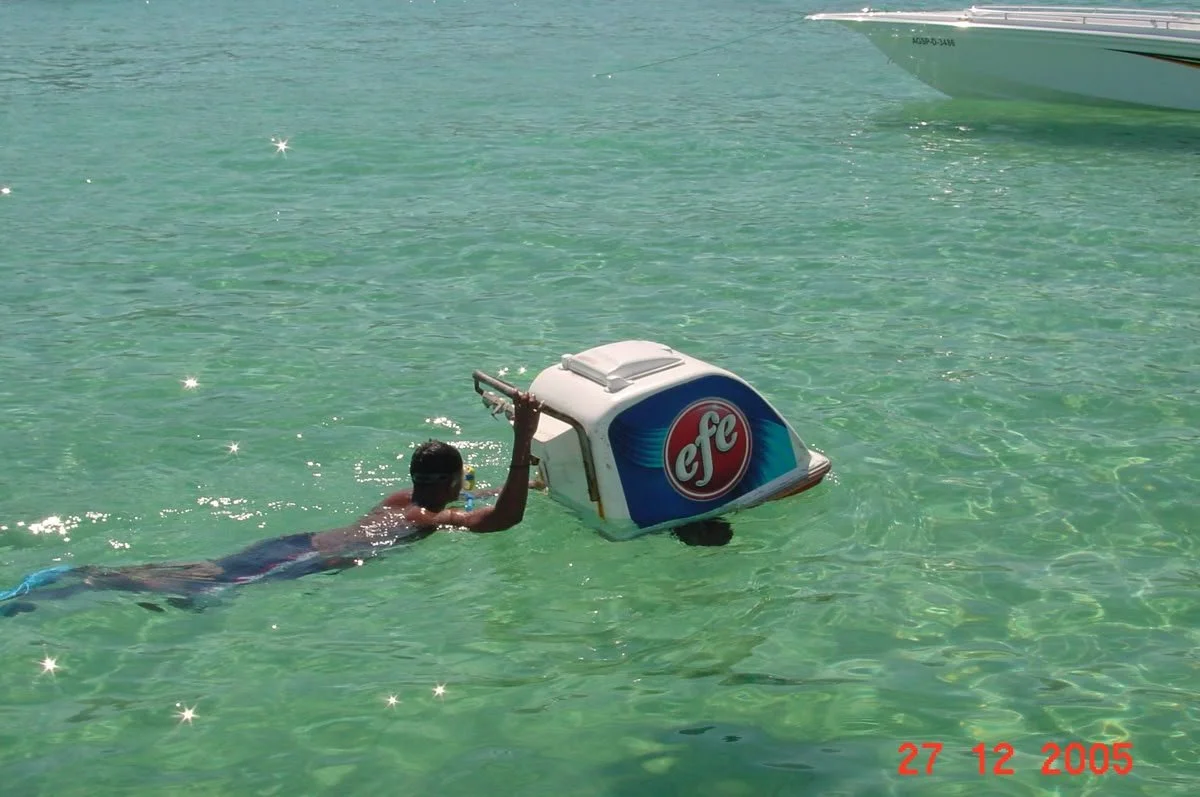
Venezuelan vendor selling ice cream in Puerto La Cruz.
This underlying condition also produces a distinct aesthetic language. Vernacular typography, hand-painted signs, hybrid constructions, and striking colors are not stylistic choices made by design rules. They are survival responses. Beauty is intuited rather than designed. It is functional, emotional, and deeply contextual. Creativity here is not about originality but about continuity, reinvention, and inherited knowledge.
The thing that catches the most my attention is that, this creativity is rarely individual. It is strongly communal, learned through observation and participation rather than formal instruction. When institutional systems fail, communities become our own infrastructure. Scarcity encourages collaboration, exchange, and care as survival strategies.
To speak about creativity born from scarcity is not to romanticize hardship. Scarcity is inherently violent, exhausting, and unequal. It takes away your youth and forces you to grow rapidly. But recognizing the solutions that emerge within it allows us to value forms of creativity that inevitably find their way through. Creativity does not only happen in well-resourced spaces; it happens in the streets, in the markets, in the common-place, wherever imagination meets necessity.
Today, living and working outside Latin America, I carry this way of seeing with me. It puts into perspective how people live and resuelven in different societies. It reminds me that constraints are not limitations and can become catalysts, and that abundance does not always come from having more, but from learning how to look, adapt, and create community.
Exploring the relationship between scarcity and creativity is, for me, an act of self-recognition. A way to honour the everyday small inventions and collective knowledge. And perhaps, a way to rethink about what abundance itself means to us.
